
The relics of the three holy virgins

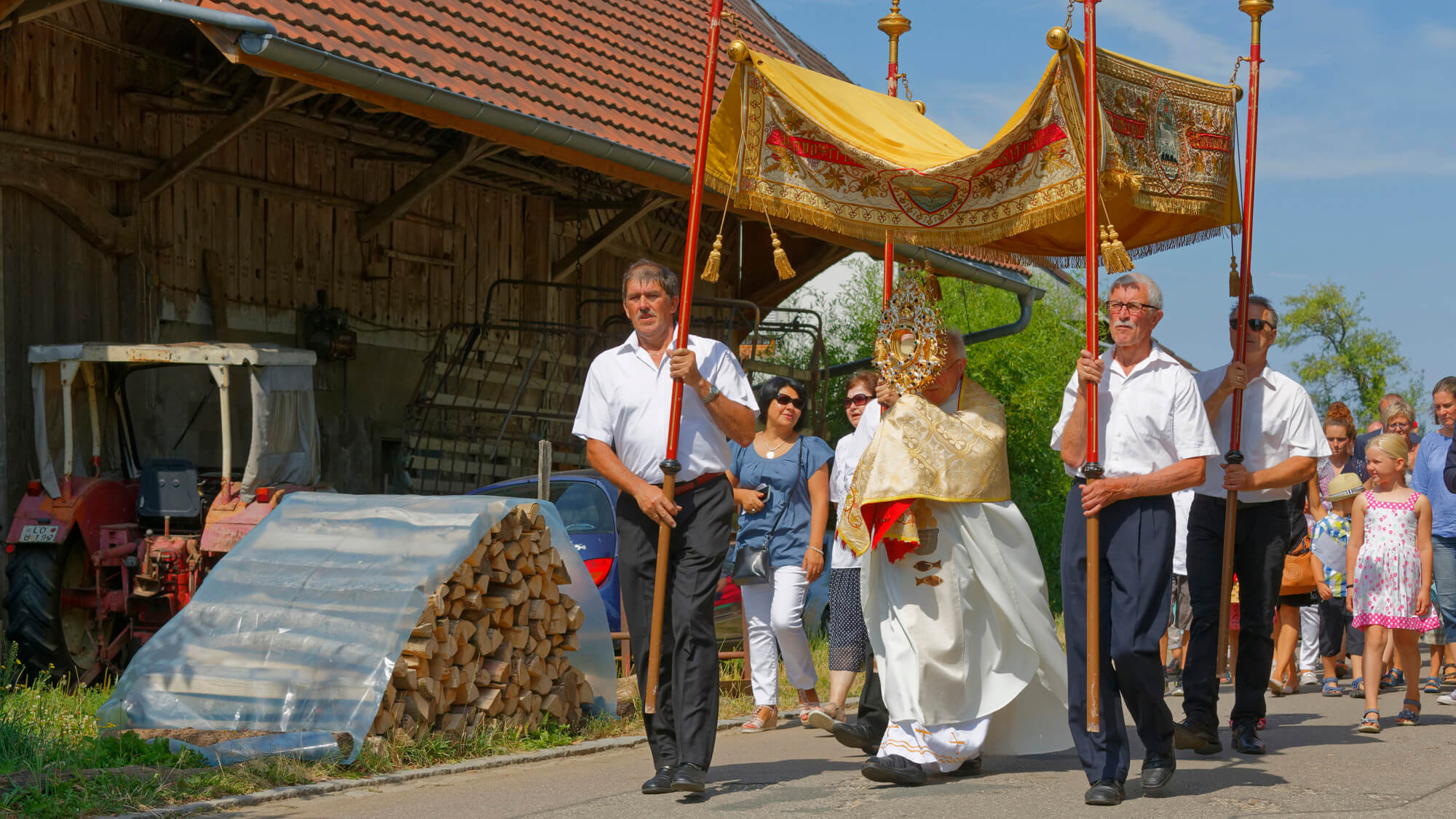
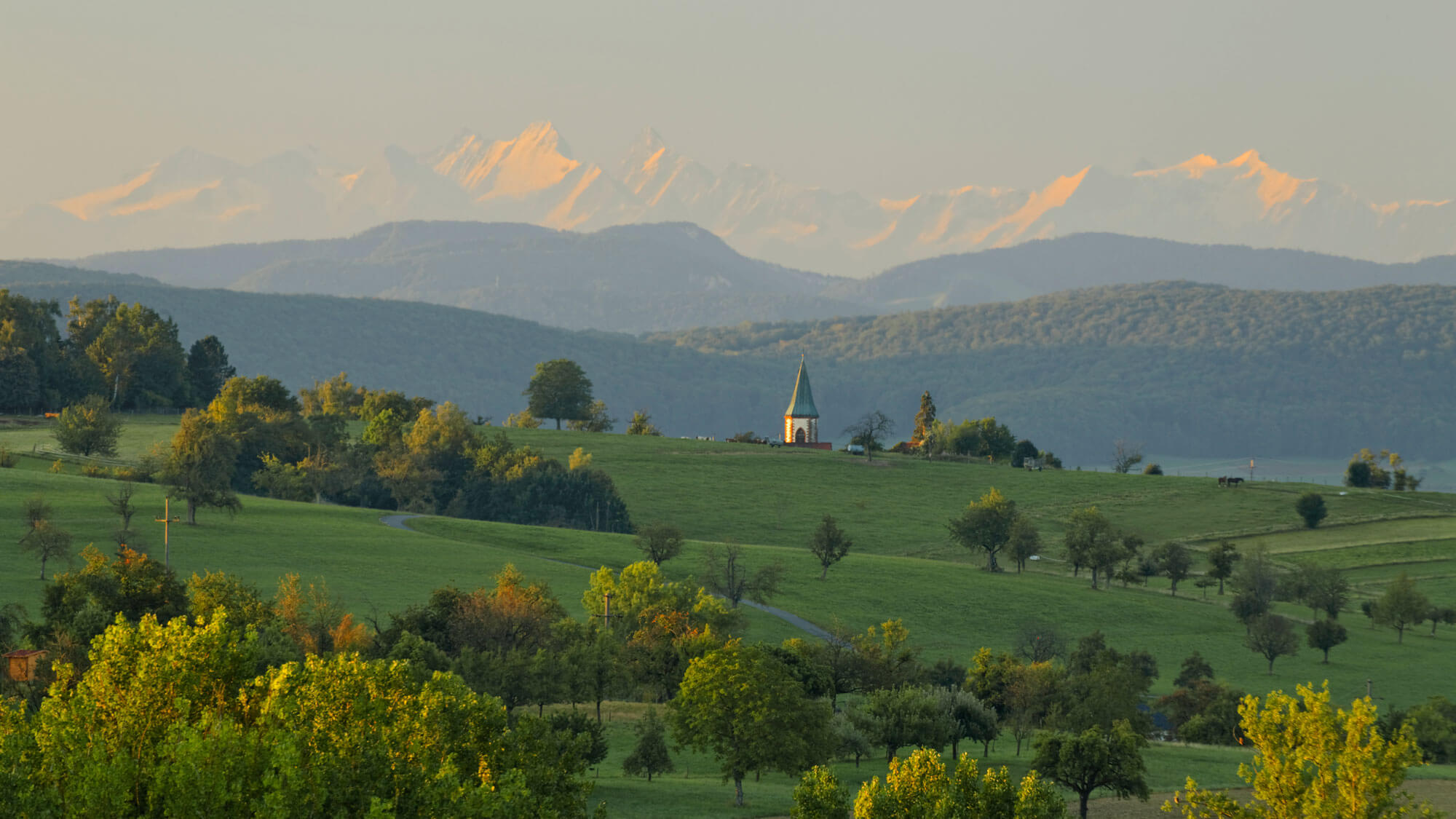
If you drive from Badisch-Rheinfelden towards Maulburg up the Dinkelberg, you will reach the Eichsler Church in the district of Obereichsel at the highest point. On a clear day, you can see as far as the Swiss Alps from here. The site was already inhabited in Roman times, and it is thought that a pre-Christian place of worship once stood on the site of the present-day church. The name Eichsel is said to derive from the term ‘oak of salvation’. On the third Sunday in July, the village becomes the centre of a time-honoured festival in honour of the three virgins Wibrandis, Kunigundis and Mechtundis. Following a festive service, the reliquaries of the saints are carried in procession around the village along a route carpeted with flowers, after which a small village festival takes place.
According to the legend, which has persisted for centuries, the three virgins were part of the retinue of Saint Ursula, whose reliquary containing her head forms part of the Basel Minster treasury. Saint Ursula is said to have been an English princess who undertook a pilgrimage to Rome before her marriage in the 5th century. She was accompanied by her ladies-in-waiting, whose number was recorded as eleven thousand due to a reading error. They travelled to Basel in small boats, walked from the landing stage up the Rheinsprung and turned right into an alley leading up to St Martin’s Church, which is now called ‘Elftausendjungfern-Gässlein’ in memory of this story. On their return from Rome, the devout group of pilgrims sold their riding and pack animals in Basel in order to continue their journey along the Rhine, as was customary at the time. In Cologne, however, the women were attacked by the Huns and suffered a martyr’s death.
According to tradition, however, some of Ursula’s companions are said to have remained behind in Basel: the three nuns Margaretha, Ottilie and Christiana (Chrischona), who established their hermitages on the hills to the south and north of the city. This story is based on a multitude of different legends. Even before reaching Basel, namely in Augst, Kunigundi’s companions, Mechtundi and Christiana, together with their maid Wibrandis, are said to have interrupted their journey due to serious illness. Christiana is said to have died shortly afterwards, whilst the remaining three women crossed the bed of the Rhine and reached the Roppersweiler farm on the Dinkelberg. As their end drew near, these Christian women requested the sacraments of the Church and a burial at the very spot to which an ox-drawn cart would of its own accord carry their bodies. According to tradition, this took place by an old oak tree. Over time, countless miracles are said to have occurred at the virgins’ graves. It is believed that a small church already stood here as early as the year 900, although Eichsel was first mentioned in a document in 1192. It cannot be ruled out that the church tower was originally a defensive tower. The tower was raised in 1852; the oldest of the four bells dates from 1687 and is dedicated to Saint Kunigunde.
The veneration of the three saints amongst the people must be very old. A process for their canonisation was initiated in 1504 under Pope Julius II. The minutes of this process were printed in 1505; early printed copies are held in the university libraries of Basel, Fribourg and Tübingen. Forty witnesses were examined at the time. Some of them gave consistent accounts of the ‘Mägdebrunnen’ spring, which was said to have miraculously gushed forth, the lovely scent of violets at the graves, and of unusual healings. Two women from Basel are said to have recovered from the plague here. The women’s graves were opened and their carefully prepared relics were placed on the church altar on 16 June 1504. Five thousand people are said to have gathered on the Dinkelberg for this celebration. Despite the Reformation in Basel in 1529 and in the Margraviate of Baden in 1556, and despite the strict ban imposed by Emperor Joseph II in 1783, the veneration of the ‘three maidens’ continued, and the large influx of pilgrims and worshippers at the Feast of the Virgins meant that what had been a purely religious occasion evolved into a folk festival featuring a fair, market stalls, music and dance events. A young vicar took offence at the commotion; in 1820, he petitioned the administrator of the Diocese of Constance to ban the festival and succeeded in having it prohibited. The pilgrimage gradually died out over time, but in its place, from 1862 onwards, the custom of the ‘Eichsler Umzug’ on the third Sunday in July emerged.
The connection between the three saints and the Ursuline order is now questioned. It is thought that the activities of the three virgins date back to the Carolingian period and are linked to the evangelisation of the Dinkelberg. However, the fact that there are three holy women here and at other ancient places of pilgrimage, such as Wentzwiller, suggests that there was already a pre-Christian place of worship on the Dinkelberg.
The church, dedicated to St Gallus, has been extended and renovated several times over the centuries, most recently in 1978/1979. In the process, the original painted ceiling was covered by the newly installed coffered ceiling. The legend of the Three Virgins had been depicted there. In the chancel, the legendary spring was sealed; as recently as 1941, ‘holy water from the spring of the Holy Three Virgins’ had still been distributed to pilgrims who had come despite the war years. On the left-hand side of the chancel, a floor slab covers the former burial site of the Three Virgins, whose remains were removed from the tomb in 1504 and placed in reliquaries. Today, the reliquaries of the Three Virgins can be seen on the right-hand side altar, alongside the statues of the saints.
 Download hiking tip as pdf
 Hike with Outdooractive
 Fahrradtour 01 bei Outdooractive anzeigen